Simulation Overview
The AREPO Code
The PICO-Cluster simulations were carried out with the AREPO code (AREPO-2 version), a moving-mesh magnetohydrodynamics (MHD) code evolved from the MillenniumTNG project. Collisionless components (dark matter, stars, SMBHs) are modelled as discrete particles with gravitational forces computed using a TreePM approach. The ICM gas is represented on an unstructured Voronoi mesh that follows the gas motion, providing the benefits of Lagrangian schemes. AREPO-2 features advances in memory management, load-balancing efficiency, and the Subfind-HBT algorithm for efficient merger tree construction.
MHD is evolved using a second-order finite-volume Godunov scheme with the HLLD Riemann solver. Divergence errors in the magnetic field are controlled with the Powell 8-wave scheme. Simulations are initialized with a uniform comoving magnetic seed field of 10−14 G at z = 127.
IllustrisTNG Galaxy Formation Model
The baseline physics incorporates the full IllustrisTNG galaxy formation model, including:
- Star formation following the Kennicutt-Schmidt relation with a Chabrier IMF
- Kinetic stellar feedback winds decoupled from hydrodynamics
- SMBH seeding, growth via Bondi-Hoyle accretion, and two-mode AGN feedback
- Gas cooling and heating including primordial and metal-line processes
- A spatially uniform redshift-dependent UV ionizing background
The IllustrisTNG model was calibrated on 25 h−1Mpc volumes; PICO-Clusters tests it in the extreme cluster environment at unprecedented resolution.
Simulation Parameters
| Parameter | Value |
|---|---|
| Parent box size | 1 h−1Gpc |
| Parent box particles | 10243 DM |
| Clusters in parent | 272 (M>1015 M☉) |
| Zoom simulations | 24 |
| Zoom factors | Z4, Z8, Z12, Z24 |
| Main zoom level | Z12 |
| Contamination-free | >2.7 R200 all times |
| Seed B-field | 10−14 G (comoving) |
| Init. redshift | z = 127 |
| Cosmology | Planck 2018 |
| Ωm | 0.316 |
| Ωb | 0.049 |
| h | 0.673 |
| σ8 | 0.81 |
Resolution Levels
PICO-Clusters are re-simulated at zoom factors 4, 8, 12, and 24 relative to the parent simulation
| Zoom Factor | DM Particle Mass (M☉) | Baryonic Cell Mass (M☉) | DM Softening (h−1kpc) | Comparable to |
|---|---|---|---|---|
| Z4 | 1.6×10⁹ | 3.0×10⁸ | 4.88 | ~TNG300-2.5 |
| Z8 | 2.0×10⁸ | 3.7×10⁷ | 2.44 | ~MTNG |
| Z12 (main) | 5.9×10⁷ | 1.1×10⁷ | 1.63 | ~TNG300 / TNG-Cluster |
| Z24 (halo 4) | 7.4×10⁶ | 1.4×10⁶ | 0.81 | ~TNG100 (but 7× more massive) |
The Z24 simulation of halo 4 (M200 = 2.7×10¹⁵ M☉) is the highest-resolution IllustrisTNG simulation of a galaxy cluster above 1015 M☉.
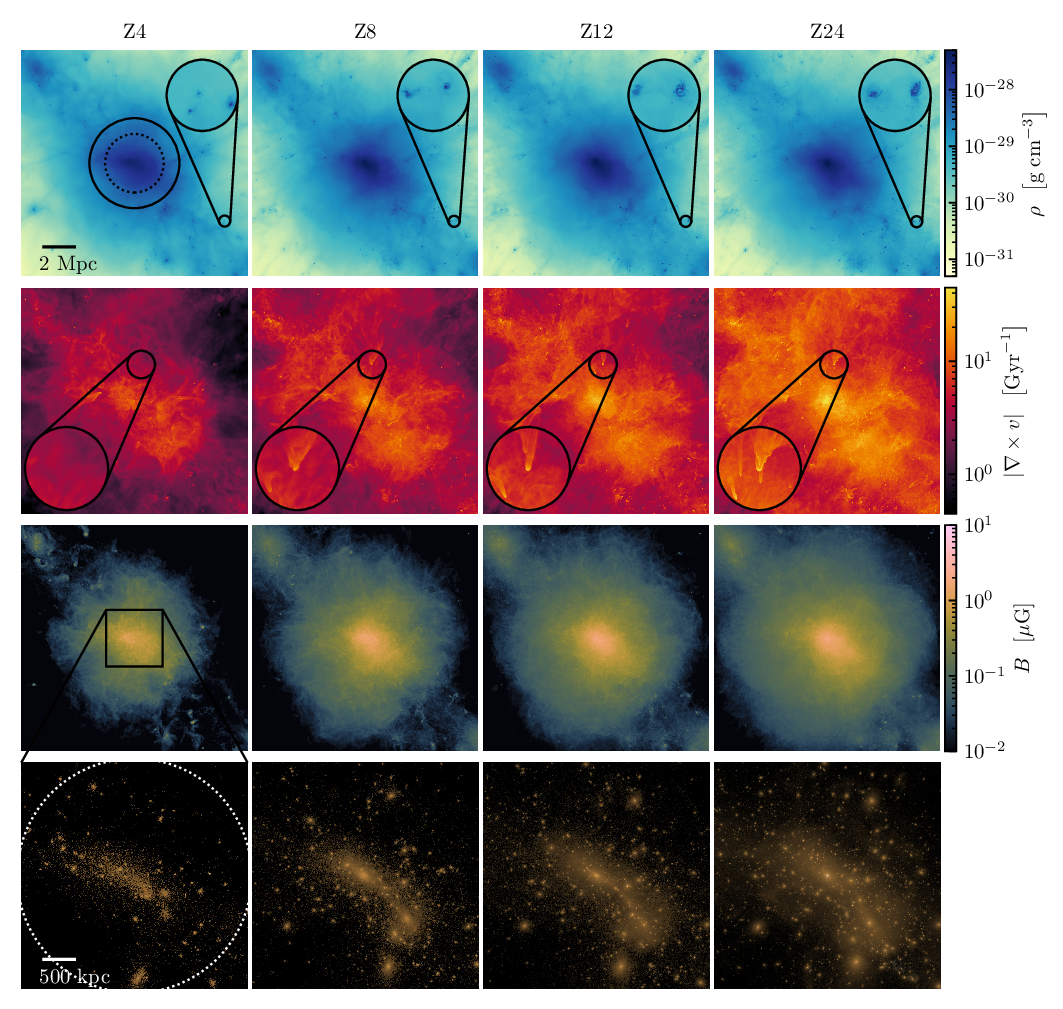
Convergence study of halo 4 at zoom factors Z4, Z8, Z12, and Z24. Rows show gas density, vorticity, magnetic field strength, and mock optical images. Higher resolutions reveal additional low-mass subhalos and finer turbulent structures. View full size →
Initial Conditions & Cluster Selection
CosmoZoomIC
Zoom-in initial conditions were created with the new CosmoZoomIC code (Puchwein et al., in prep.). The code uses a hierarchical tree structure to concentrate resolution in the Lagrangian region of each cluster and its environment out to 5 R200, allowing the high-resolution zone to trace the arbitrarily shaped Lagrangian volume, with a gradual transition to the coarse background grid.
Two key techniques prevent contamination by low-resolution particles:
- Filling "holes" in the Lagrangian region by iterative neighbour-flagging
- Adding one additional layer of high-resolution grid points around the flagged region
All clusters are confirmed free of contamination within at least 2.74 R200 at all simulation outputs, with the typical minimum contamination radius exceeding 4 R200.
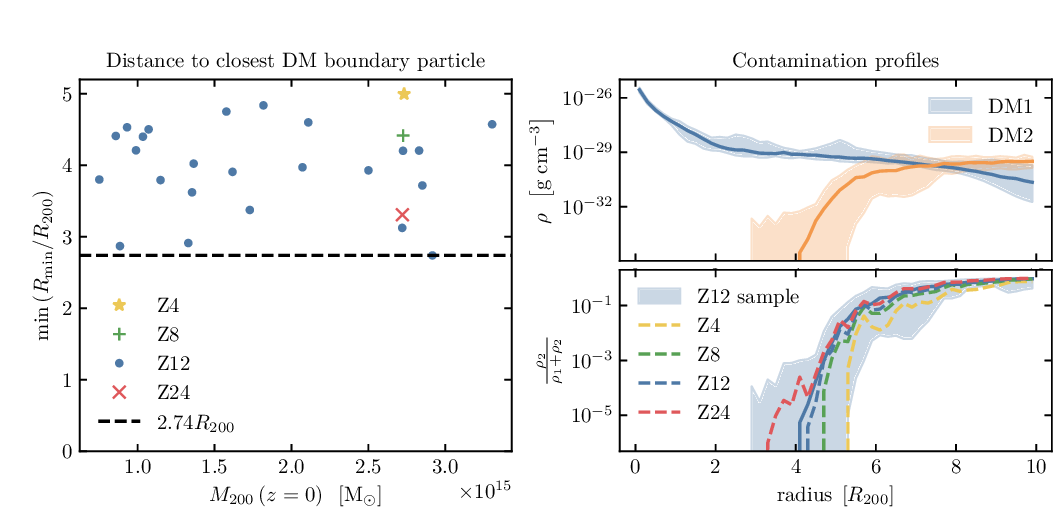
Left: minimum contamination radius vs. cluster mass for all simulations. Right: density distributions of high- and low-resolution particles at z=0. View full size →
Parent Box & Halo Selection
Clusters were selected from a 1 h−1Gpc non-radiative MHD parent simulation with 10243 DM particles (Planck 2018 cosmology). All 272 halos above 1015 M☉ were identified at z = 0.
The 24 selected clusters have a flat distribution in log(M200) between 1014.9 and 1015.4 M☉, with the five most massive halos always included. This mass range extends well beyond the most massive clusters in TNG100 (3.8×10¹⁴ M☉) and TNG50 (1.8×10¹⁴ M☉).
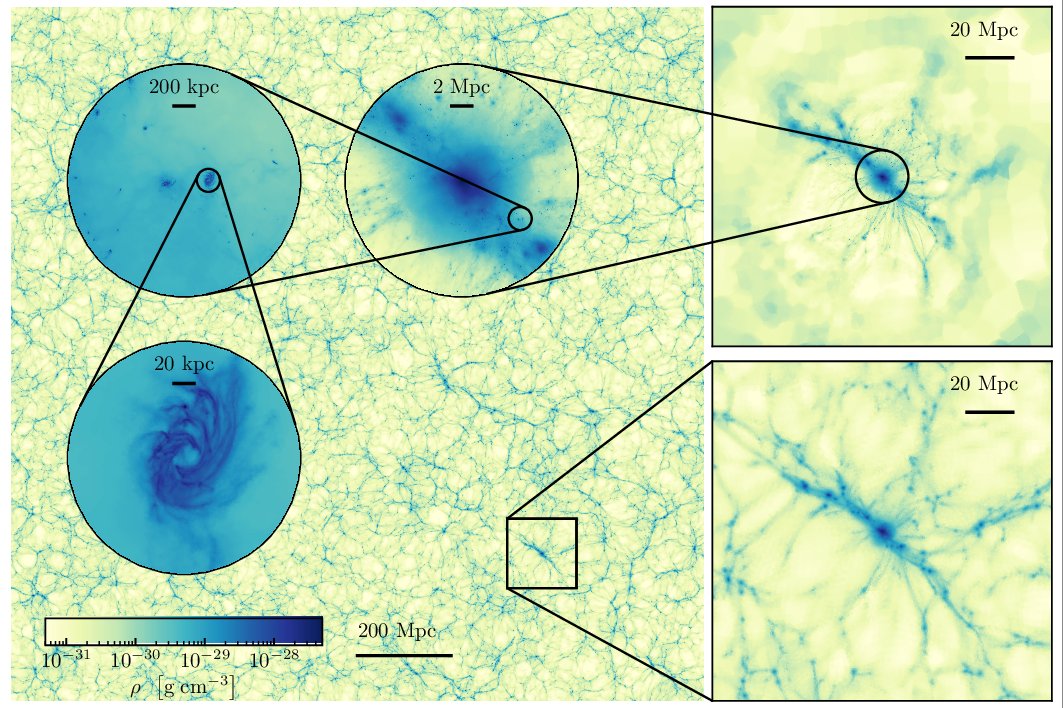
The parent simulation showing the cosmic web (left), a string of clusters (lower right), and the Z24 zoom-in re-simulation of halo 4 (upper right). View full size →
The PICO-Cluster Sample
24 clusters at zoom factor Z12 (plus convergence study of halo 4 at Z4, Z8, Z24)
| # | Halo | Zoom | M500 [1015 M☉] | M200 [1015 M☉] | min(Rmin/R200) | Physics versions | Image at z=0 click for full size |
|---|---|---|---|---|---|---|---|
| 1 | 0 | 12 | 2.009 | 3.304 | 4.57 | TNG |  |
| 2 | 1 | 12 | 2.076 | 2.916 | 2.74 | TNG | 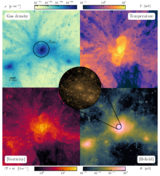 |
| 3 | 2 | 12 | 1.567 | 2.851 | 3.72 | TNG | 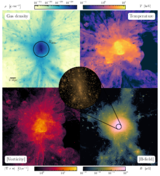 |
| 4 | 3 | 12 | 1.972 | 2.720 | 3.12 | TNGNONRAD | 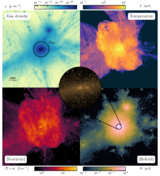 |
| 5 | 4 | 4/8/12/24 | 1.743–1.879 | 2.721–2.732 | 3.31–5.00 | TNGNONRAD | 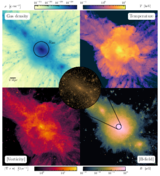 |
| 6 | 8 | 12 | 2.192 | 2.830 | 4.21 | TNG | 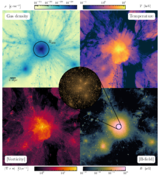 |
| 7 | 9 | 12 | 1.699 | 2.500 | 3.93 | TNG | 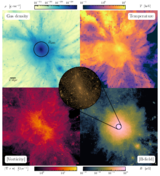 |
| 8 | 19 | 12 | 1.599 | 2.109 | 4.60 | TNG | 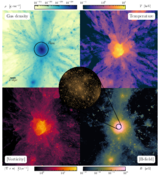 |
| 9 | 22 | 12 | 1.347 | 2.072 | 3.97 | TNG | 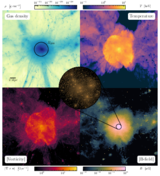 |
| 10 | 33 | 12 | 1.353 | 1.818 | 4.84 | TNG | 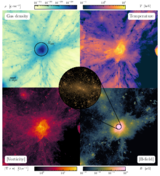 |
| 11 | 41 | 12 | 1.164 | 1.729 | 3.37 | TNG | 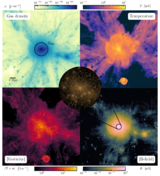 |
| 12 | 49 | 12 | 1.024 | 1.617 | 3.91 | TNG | 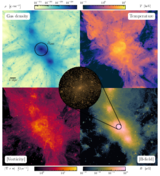 |
| 13 | 56 | 12 | 0.955 | 1.577 | 4.75 | TNG | 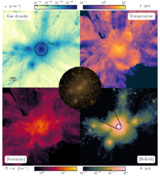 |
| 14 | 98 | 12 | 0.997 | 1.364 | 4.02 | TNG | 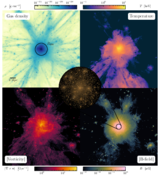 |
| 15 | 104 | 12 | 0.936 | 1.354 | 3.62 | TNG | 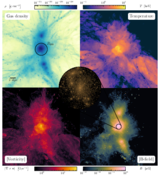 |
| 16 | 112 | 12 | 0.939 | 1.329 | 2.91 | TNG | 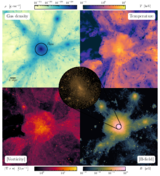 |
| 17 | 194 | 12 | 0.601 | 1.034 | 4.40 | TNGNONRAD | 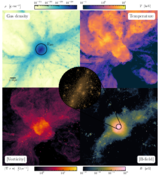 |
| 18 | 239 | 12 | 0.728 | 1.071 | 4.50 | TNGJET | 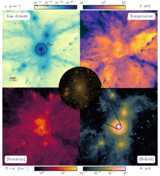 |
| 19 | 260 | 12 | 0.681 | 1.149 | 3.79 | TNGJETNONRAD | 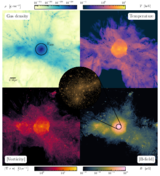 |
| 20 | 261 | 12 | 0.615 | 0.989 | 4.21 | TNG | 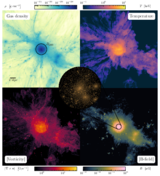 |
| 21 | 344 | 12 | 0.664 | 0.932 | 4.53 | TNG | 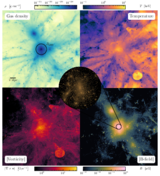 |
| 22 | 417 | 12 | 0.547 | 0.858 | 4.41 | TNG | 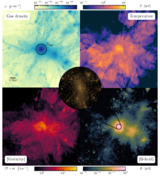 |
| 23 | 420 | 12 | 0.530 | 0.885 | 2.87 | TNGJET | 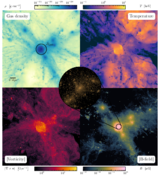 |
| 24 | 542 | 12 | 0.440 | 0.751 | 3.80 | TNG | 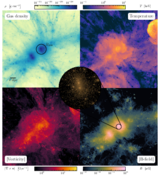 |
Masses are at z = 0 in the zoom-in IllustrisTNG simulation. min(Rmin/R200) is the minimum over all output times of the closest lower-resolution particle. All clusters are contamination-free within at least 2.74 R200. Physics versions: TNG = IllustrisTNG galaxy formation model; JET = explicit AGN jet feedback; NONRAD = non-radiative MHD (no cooling, star formation, or feedback).
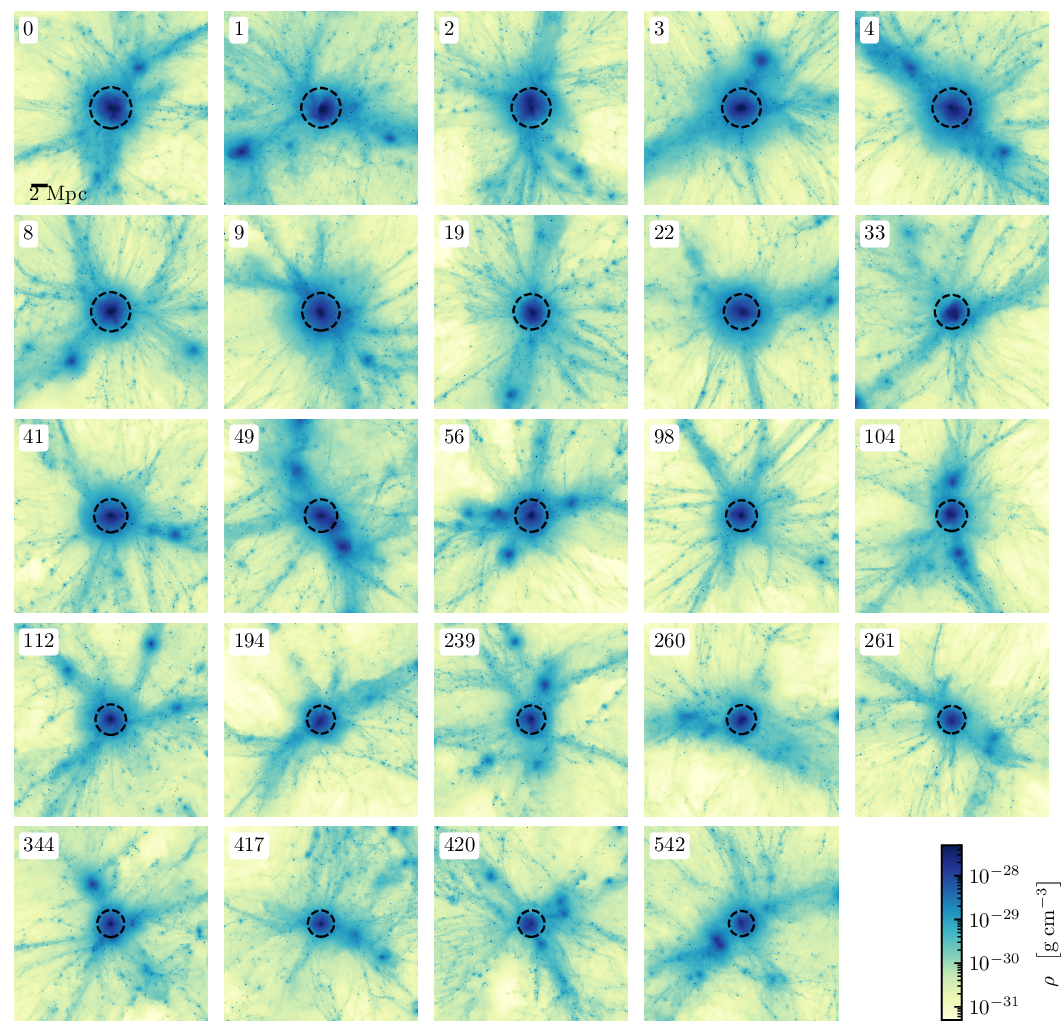
Gas density projections of all 24 PICO-Cluster galaxy clusters at Z12 resolution at z=0. Circles indicate R200. View full size →