Physics Model Variants
Re-simulations that modify one aspect of the baseline TNG physics to isolate its effect
The general strategy of the PICO-Cluster project is to use the IllustrisTNG model as a controlled baseline and then systematically vary one physical ingredient at a time. Some variants strip out components of the galaxy formation model to isolate their role; others extend the baseline with new physics not present in TNG.
Controlled Comparison Runs
Non-radiative MHD Re-simulations Tevlin et al. (2025)
Four PICO-Cluster halos were re-simulated with non-radiative MHD — switching off gas cooling, star formation, and all feedback — to isolate the role of galaxy formation physics in the growth of cluster magnetic fields. Comparing these runs to the full-physics baseline shows that galactic feedback is crucial for growing the magnetic coherence length to scales exceeding the ion mean free path, which is a prerequisite for MHD descriptions of the ICM small-scale dynamo.
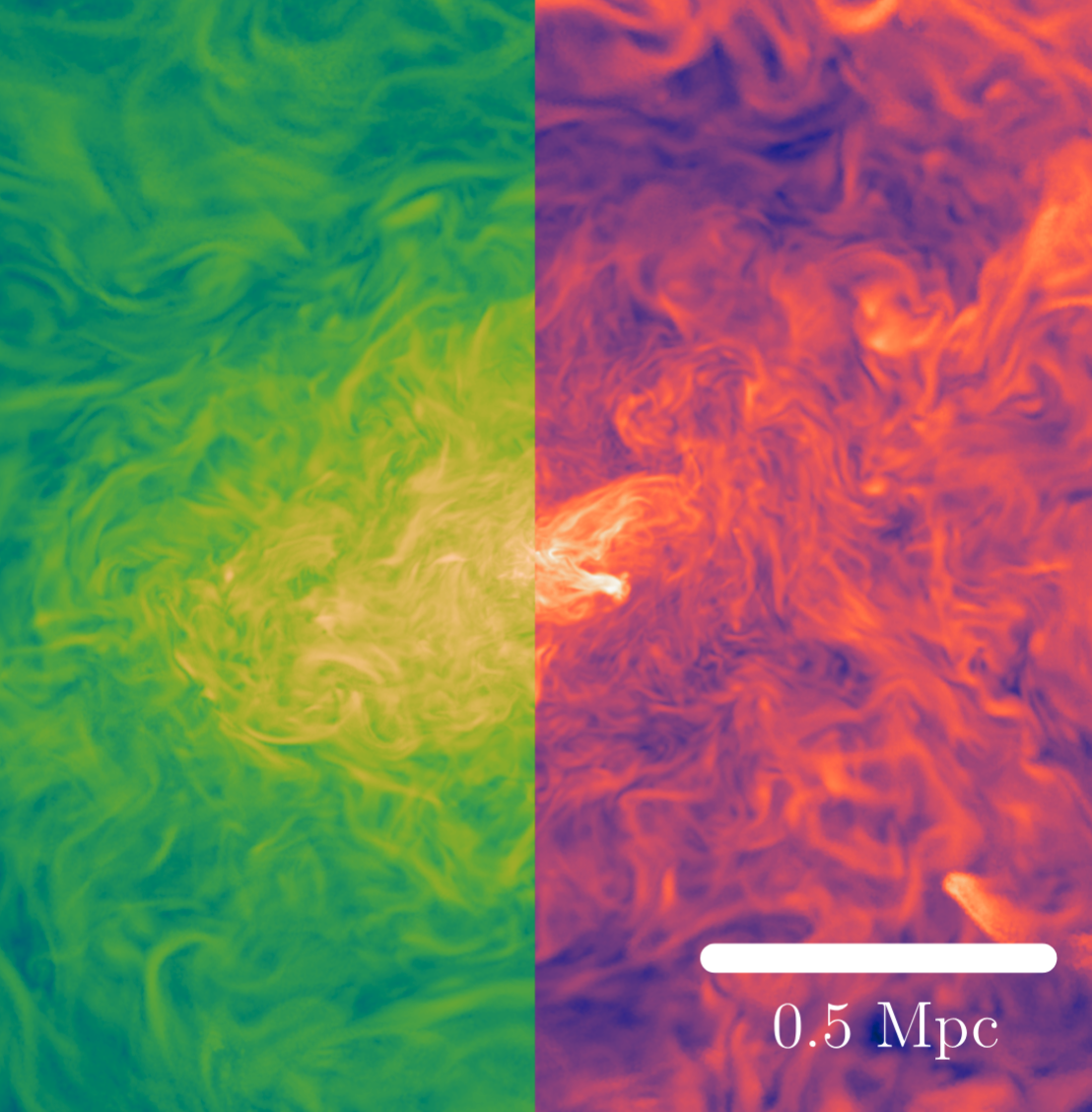
Magnetic field strength (left) and vorticity (right) in a run with TNG physics.
Key Result
Galaxy formation physics — in particular galactic winds and AGN feedback — drives the magnetic coherence length above the particle mean free path, enabling the MHD dynamo regime in the ICM.
Advanced Physics Models
AGN Jet Simulations Weinberger et al. (submitted)
Feedback from active galactic nucleus (AGN)-driven jets plays a crucial role in shaping the inner regions of the intracluster medium. However, because these jets originate close to the event horizon of the central supermassive black hole, modelling their impact across galaxy-cluster scales poses an enormous dynamic-range challenge. As a result, the prescriptions used to capture these effects are necessarily simplified and remain highly uncertain.
To investigate the role of AGN-driven jets in galaxy clusters, we employ an explicit collimated jet model based on Weinberger et al. (2017) and Weinberger et al. (2023). While this model has been applied in more idealised numerical setups, we use it here for the first time in a cosmological context, examining the interplay between intrinsic effects (feedback) and extrinsic effects (cluster assembly and satellite galaxies) in shaping the kinematics and thermodynamics of the intracluster medium.
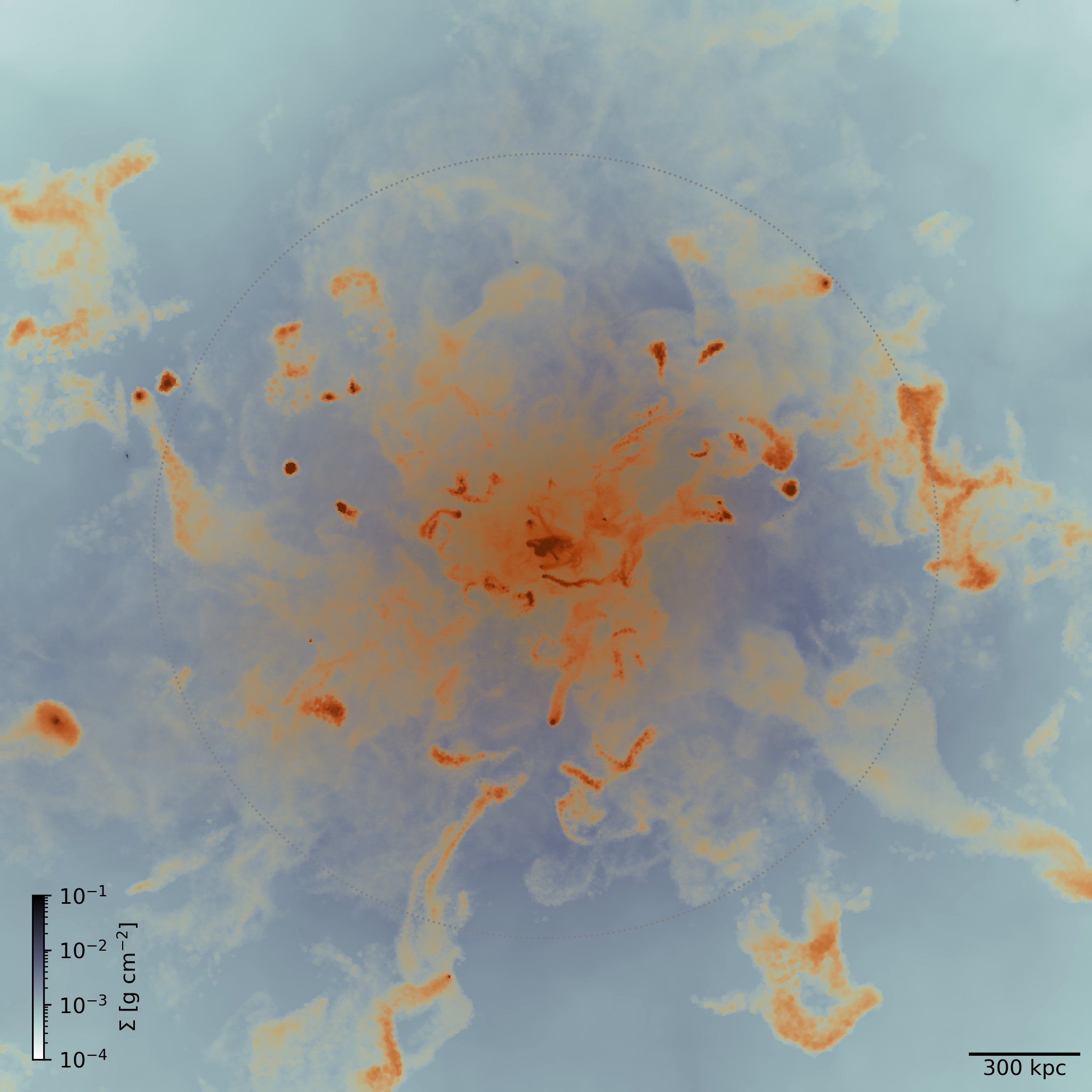
Large scale jet material distribution (red) and intra-cluster medium column density (greys)
Key Results
Explicit AGN jet feedback is able to maintain a realistic cool core by balancing radiative cooling losses while suppressing star formation. Comparisons between cosmological and more idealised setups show that cosmological assembly strongly influences the kinematics of the ICM and the distribution of multiphase gas beyond the cluster core. The central AGN-driven jet is primarily responsible for establishing the thermodynamic conditions in the core, including its central temperature and entropy levels.
Further Variants Planned
- Cosmic-ray transport
- Anisotropic thermal conduction
- Further models to follow