Plasma Physics
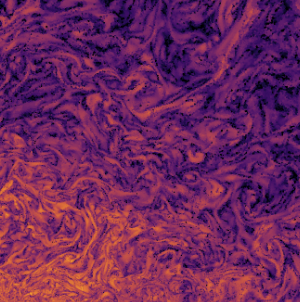
PICO-Clusters is designed to study plasma-physical processes in the intracluster medium — magnetic field growth, Faraday rotation, anisotropic viscosity (Braginskii MHD), thermal conduction, and cosmic rays — using cosmological zoom-in simulations.
Unprecedented Resolution
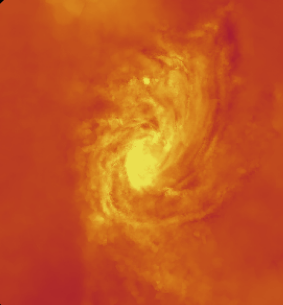
Our highest-resolution run (Z24) achieves a baryonic mass resolution of 1.4×10⁶ M☉ for clusters with M200 > 1015 M☉ — the highest-resolution IllustrisTNG simulation of galaxy clusters at this mass scale.
Cluster Sample
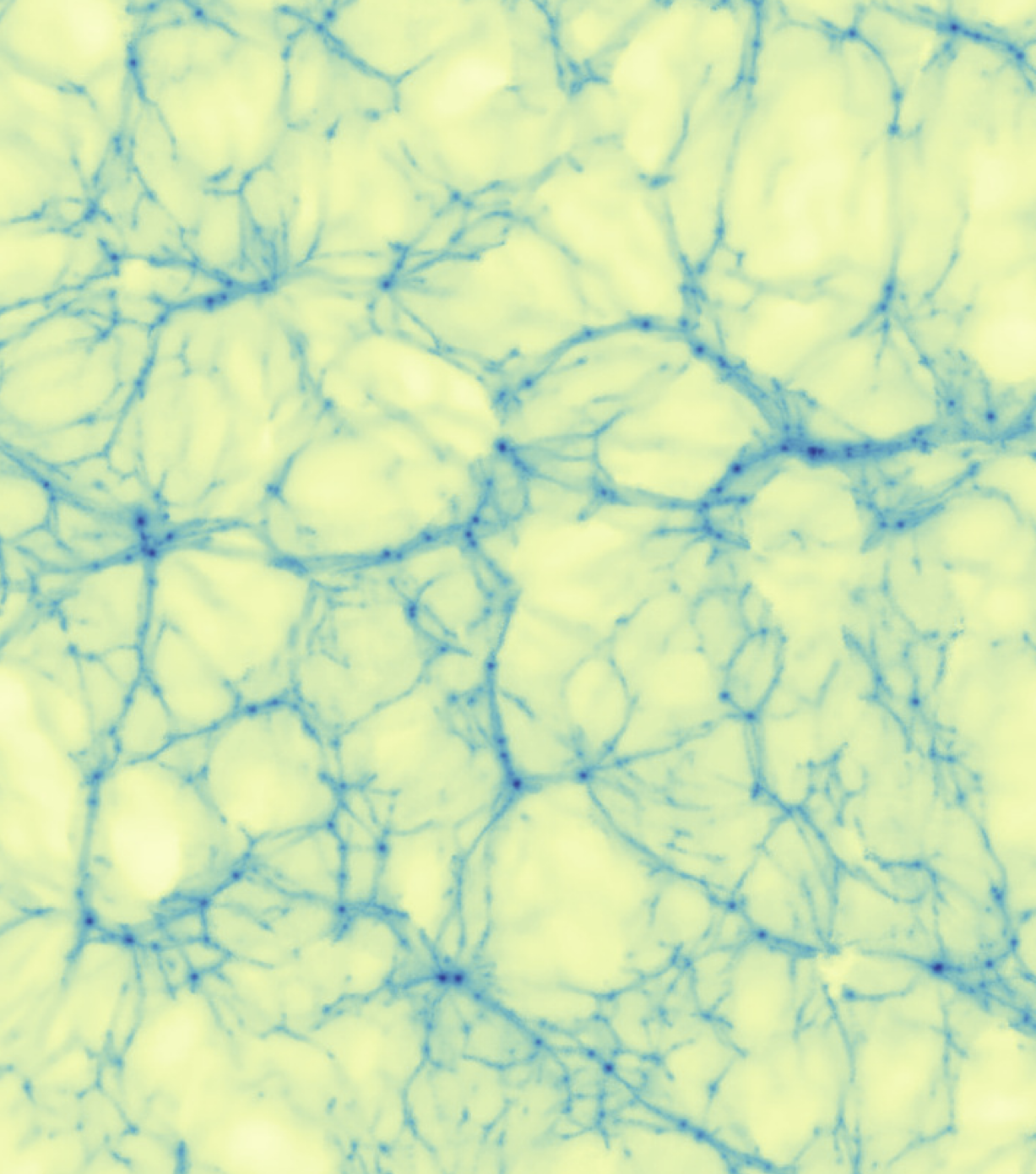
24 massive galaxy clusters selected from a 1 h−1Gpc parent simulation box containing 272 clusters above 1015 M☉. The 24 zoom targets were chosen to have a flat distribution in logarithmic mass, with contamination-free regions extending to at least 2.7 R200.
About the Project
Studying Plasmas In COsmological Clusters with modern galaxy formation and physics models
Galaxy clusters are the largest gravitationally collapsed structures in cosmic history, and their intracluster medium (ICM) constitutes a unique laboratory for plasma astrophysics. A well-defined hierarchy of energy densities — thermal > kinetic > magnetic ≈ cosmic rays — allows controlled studies of non-thermal processes relevant across a wide range of astrophysical environments.
The ICM hosts a rich variety of phenomena: cosmic-ray acceleration and non-thermal radio emission, subsonic turbulence and the magnetohydrodynamic dynamo, weakly collisional plasma physics, and the transformative effects of ram-pressure stripping and AGN feedback on member galaxies. To investigate these processes, we introduce the PICO-Cluster Project — studying "Plasmas In COsmological Clusters" with a suite of high-resolution cosmological zoom-in simulations of massive galaxy clusters with masses ≳1015 M☉.
The 24 baseline simulations employ the moving-mesh AREPO code (AREPO-2 version) with the IllustrisTNG galaxy formation model. The initial conditions are constructed with a new CosmoZoomIC code to prevent contamination by lower-resolution particles within 2.7 R200 at all times for all clusters. PICO-Clusters studies how plasma-physical processes — anisotropic viscosity, thermal conduction, cosmic rays, and AGN feedback — alter the properties of galaxy clusters relative to a baseline MHD model. The general strategy is to use the IllustrisTNG model as a baseline and then replace or extend one specific aspect of the physics to learn from the differences. Examples include replacing the standard AGN feedback with explicit AGN jet simulations, adding cosmic-ray transport, or running non-radiative MHD re-simulations to isolate and characterize the magnetic dynamo driven by ICM turbulence.
A Massive Galaxy Cluster at Unprecedented Resolution
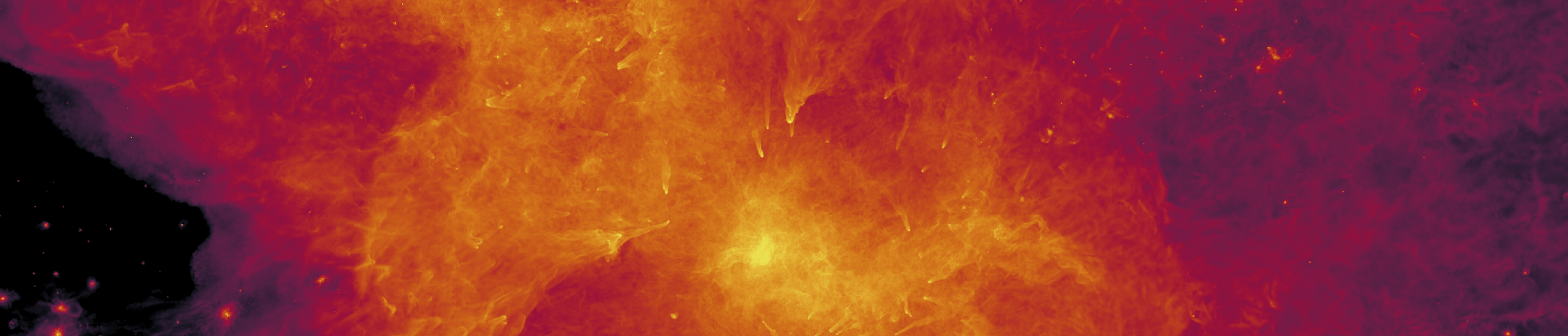
Halo 4 — M200 = 2.7×10¹⁵ M☉ at zoom factor Z24
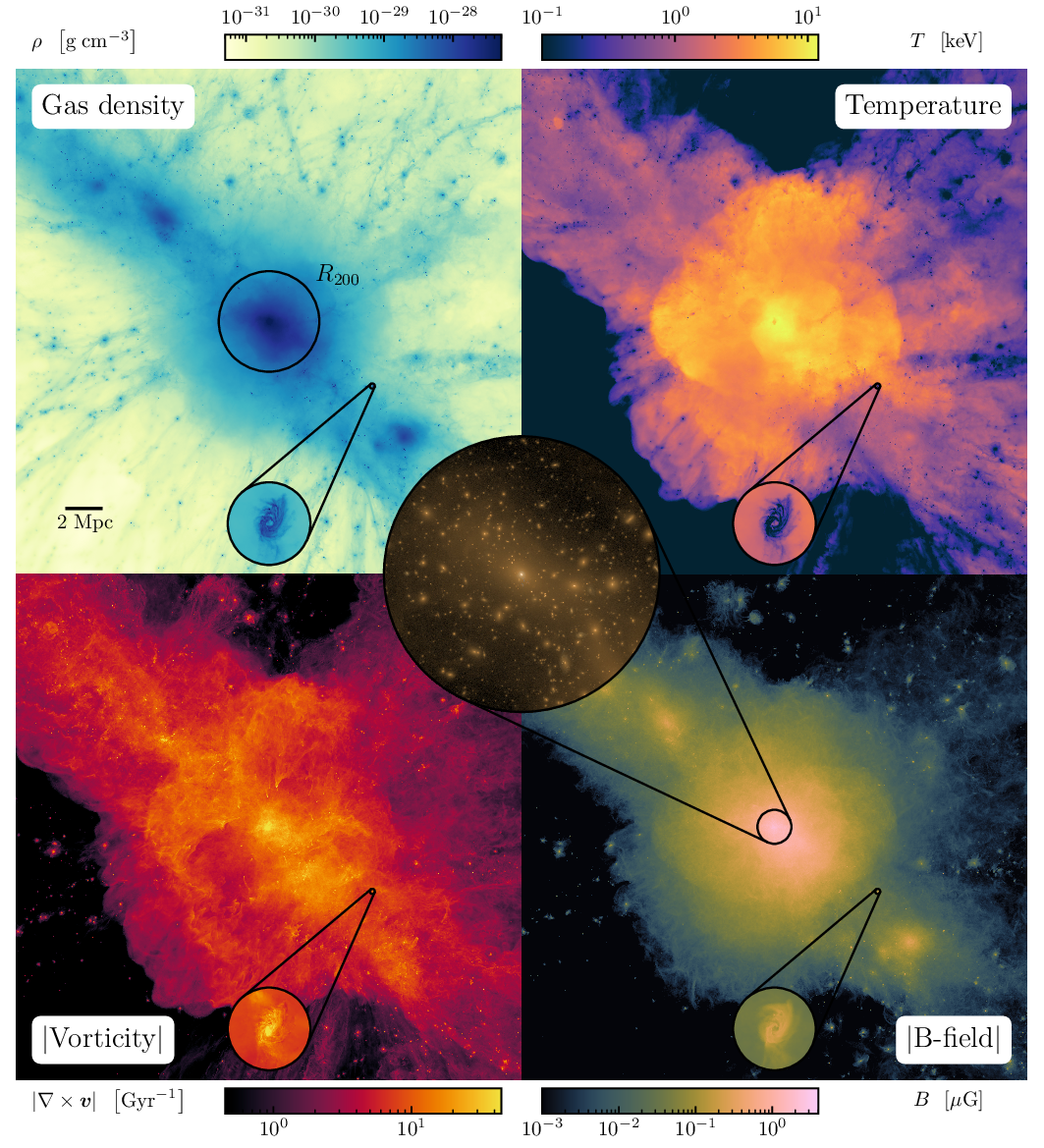
Deep projections (15 Mpc) of gas density, temperature, vorticity and magnetic field at z=0. A mock Hubble Space Telescope image of the central stellar content is inset. The zoom-in shows an individual spiral galaxy external to the cluster. View full size →